
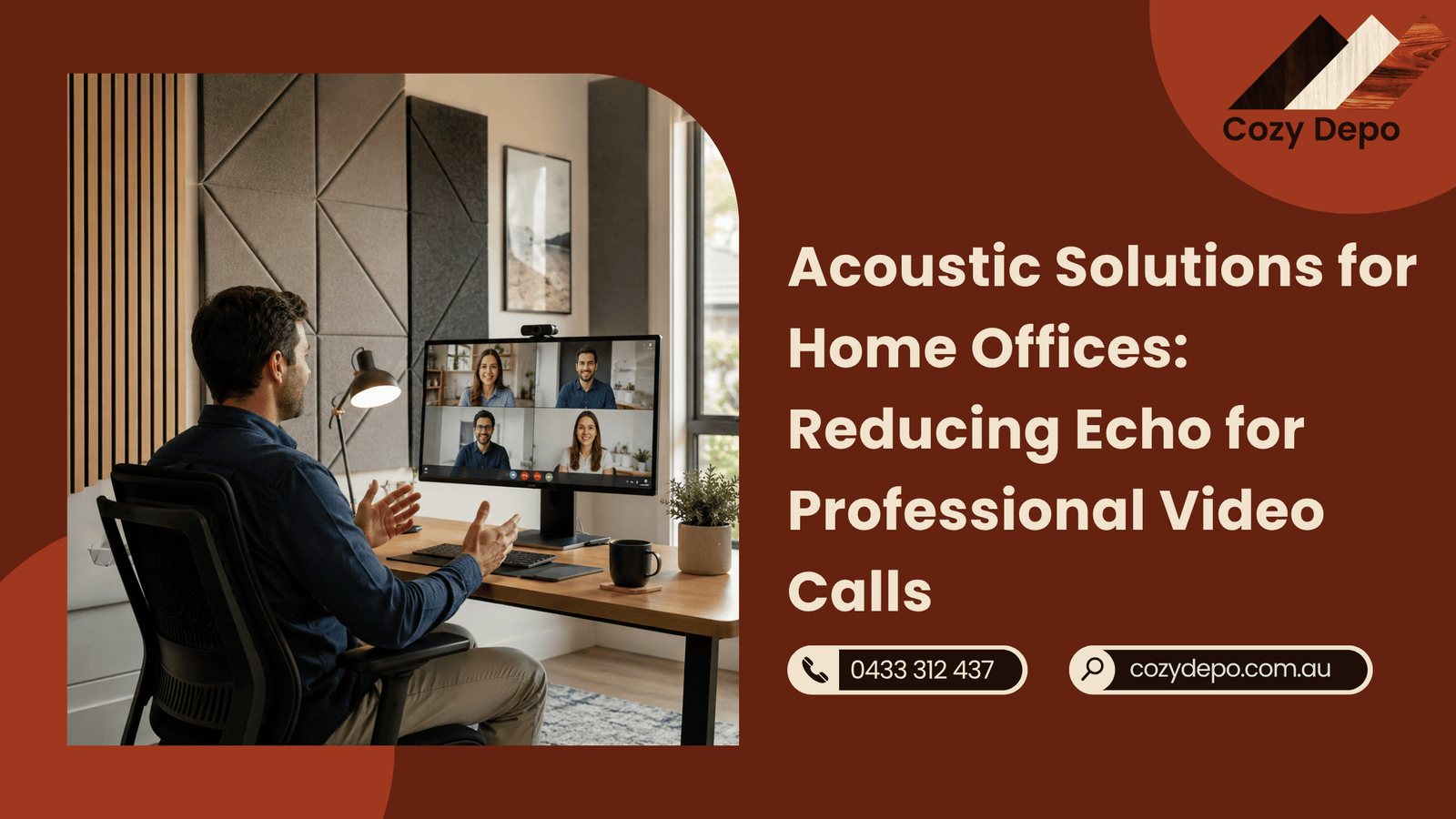
Working from home has its perks, but there’s one thing nobody warns you about: how weirdly loud an empty room can sound. The blank walls, wooden floors, and huge windows do not absorb sound; they amplify it.
You notice it most on video calls. This happens when you participate in a meeting using Zoom, Teams, an interview with a customer, or just have a brief conversation with your manager, while your microphone is functioning properly and there is no issue with your internet.
The fix doesn’t have to mean gutting the room. A bit of smart acoustic treatment, including custom acoustic panels Melbourne homeowners can get made for their exact space, usually does the trick.
Why Does a Home Office Sound Echoey?
Echo is really just sound bouncing off hard surfaces instead of getting absorbed. The fewer soft surfaces a room has, the more that bouncing happens.
Most home offices are full of exactly the wrong materials for good acoustics:
- Plasterboard walls
- Glass windows
- Timber or tiled flooring
- A hard desk surface
- Shelving, cupboards
- Barely any soft furnishings
None of that is a problem for daily life. It’s just not doing anything to control sound.
So what happens on a call is your mic picks up your actual voice plus all those reflections at once, and the result is speech that sounds muddy or unclear.
How Acoustic Panels Improve Video Calls
Acoustic panels work by soaking up some of that bouncing sound energy before it has a chance to reflect back.
That means less echo and speech that comes through noticeably cleaner, which matters a lot if you’re on calls with clients or colleagues most days.
Picture a typical Melbourne home office: a desk against one wall, a big window opposite, and timber floors underneath. Even a great microphone can’t fully hide that “room sound”. Treat the spots where sound actually reflects, though, and you fix the issue without touching the rest of the room.
Absorption vs Soundproofing
People mix these up constantly, so it’s worth clearing up.
Acoustic treatment deals with sound inside the room, echo, reverberation, and that hollow quality.
Soundproofing is about stopping sound from moving between rooms or from outside in. It usually means extra wall mass, insulation, sealing gaps, that sort of thing.
If your issue is “my voice sounds echoey on calls”, you want absorption, not soundproofing. Different problem, different fix.
Where Should You Place Acoustic Panels?
You don’t need to plaster every wall with panels. Where you put them matters far more than how many you buy.
Start by figuring out which surfaces are actually causing the reflections.
Behind Your Desk
A panel behind where you sit tames the reflections coming off that wall and as a bonus, it usually looks a lot better on camera than bare plasterboard.
On the Opposite Wall
The wall facing you is often doing just as much damage. Sound bounces off it and heads straight back toward your mic.
Near Hard Side Walls
Smaller offices especially feel side-wall reflections. If your room’s tight, a panel or two on the side walls helps more than you’d expect.
Around Large Reflective Areas
Windows are big offenders. Curtains, rugs, and other soft bits paired with panels help calm the whole room down together.
A quick trick: clap once in your office. A sharp, ringing slap-back tells you exactly where the problem surfaces are.
Choosing Custom Acoustic Panels Melbourne Homeowners Can Use
No two home offices are the same. A tiny converted nook, a spare bedroom, and an open-plan corner of the living room – they all need different treatment.
That’s really where custom acoustic panels Melbourne options earn their keep. Rather than grabbing a generic panel and hoping it fits, you can size and design around your actual room’s dimensions, its furniture, its walls, and even its colour scheme.
Worth thinking about when comparing panels:
- Size and thickness
- Absorption performance
- Available wall space
- Colour, finish
- How they’re installed
- Overall office look
- Whether they land on real reflection points
The aim isn’t a dead-silent room. It’s a balanced sound where speech still feels natural, just without the echo.
Simple Ways to Improve Home Office Acoustics
Panels help a lot, but a few small changes around them go a long way too.
Add a Rug
Timber, tile, or vinyl floors reflect sound straight up. A decent-sized rug under your desk area softens that.
Use Curtains
Heavy curtains absorb reflections off windows, and they cut glare on your camera too.
Add Soft Furnishings
Cushions, books, fabric chairs, anything irregular helps break up reflections. You’re not building a studio, just softening a box.
Move the Desk
Sometimes the simplest fix is repositioning. Avoid sitting your mic right between two hard parallel walls, since that’s where reflected sound really piles up.
Common Acoustic Mistakes to Avoid
Treating every wall. More panels isn’t automatically better; overdo it and the room starts sounding flat and lifeless.
Choosing on looks alone. A gorgeous panel that doesn’t actually absorb much won’t fix your echo. Check the specs, not just the colour swatch.
Confusing echo with outside noise. If it’s traffic or a noisy neighbour you’re hearing, panels won’t solve that; that’s a soundproofing job, not an absorption one.
Forgetting the microphone. Even a well-treated room needs decent mic placement. The two work together, not one instead of the other.
FAQs About Home Office Acoustic Treatment
1. Are custom acoustic panels Melbourne suitable for small home offices?
Yes, small rooms often need it more, since reflections build up fast in a tight space. It’s about placement, not room size.
2. Will acoustic panels completely remove echo?
They reduce it significantly, but “completely gone” isn’t realistic or even desirable. Some natural room sound is fine.
3. Are acoustic panels the same as soundproof panels?
No. Panels improve sound quality inside the room; soundproofing stops sound travelling between rooms.
4. Can I fix my video-call audio without renovating?
Definitely. Rugs, curtains, better mic positioning, and a few well-placed panels can do it without any construction work.
5. How many acoustic panels does a home office need?
There’s no fixed number; it comes down to the room’s size, surfaces, and how much echo you’re actually dealing with. Test the room first.
Conclusion
A home office that sounds professional doesn’t need to look like a recording booth. Deal with the hard surfaces, fix the worst reflection points, and your calls will sound noticeably clearer almost overnight.
If you’re after custom acoustic panels Melbourne made to actually fit your space and style, Cozydepo is a good place to start figuring out what your room needs.