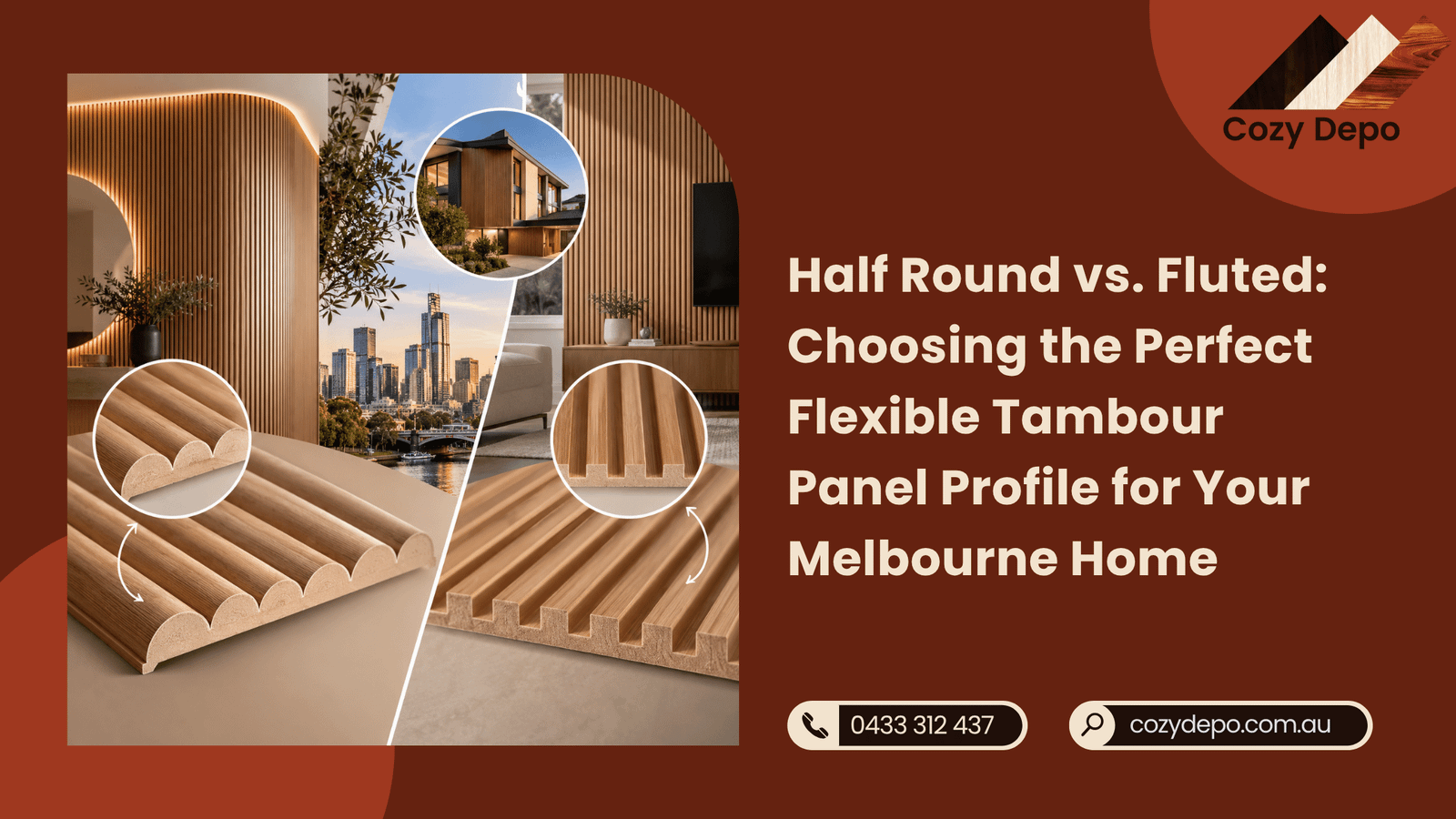
A new wall finish can change how a room feels without a big renovation. That’s why more Melbourne homeowners are looking at tambour panels. They add texture, warmth and a bit of architectural character to walls, cabinets and curved surfaces.
But not all tambour looks the same. Half-round and fluted are the two most popular profiles. The right pick depends on your style, your room size and how much texture you actually want.
If you’re comparing flexible tambour wood panels Melbourne options, knowing the difference between half-round and fluted makes the decision a lot easier.
What Are Flexible Tambour Panels?
Flexible tambour panels are narrow timber slats fixed onto a bendy backing, usually fabric or felt. That backing lets the panel follow curves and slightly uneven surfaces. Rigid wall panels just can’t do that.
You’ll often see them on:
- Feature walls
- Wardrobe fronts
- Room dividers
- Kitchen islands
- Curved counters
- TV units
- Rounded columns
This flexibility suits modern Melbourne interiors well. Arched doorways, curved sofas and rounded joinery are everywhere right now, and tambour handles those shapes easily.
Half-Round vs. Fluted: What Is the Difference?
It all comes down to the shape of each slat.
Half-Round Tambour Panels
Half-round slats have a smooth, domed top. The surface looks soft and flowing, and light slides gently over each curve. The overall feel is warm and a little decorative.
Choose it when you want:
- Softer interior style
- Subtle statement wall
- Curved furniture detail
- Natural timber look
- Relaxed, welcoming mood
Think of a bedroom bedhead or the front of a curved reception counter. Half-round looks right at home in both.
Fluted Tambour Panels
Fluted panels have sharper grooves and ridges. That gives you stronger vertical lines and a more structured look.
They suit:
- Contemporary living rooms
- Modern cabinetry
- TV feature walls
- Entryway furniture
- Office interiors
- Minimalist spaces
Those vertical lines also pull the eye upward, so a wall can look taller. That’s handy if your ceilings are on the lower side.
How Should You Choose Between the Two?
No single profile suits every home. Look at the whole room first.
1. Think About Your Interior Style
Got curved furniture, neutral colours and soft finishes? Half-round will probably blend right in.
Fluted fits sharper, more modern interiors, where clean lines and strong geometry are already part of the look.
2. Consider the Amount of Texture
Half-round gives a gentler rhythm. Fluted feels bolder because the grooves and vertical pattern stand out more.
If your room already has patterned flooring, loud artwork or chunky textured furniture, go simpler. Otherwise the space can feel busy fast.
3. Look at Natural Light
Light in Melbourne homes varies a lot. It depends on orientation, window size and what’s built around you.
Before you commit, picture how the sun and lamps will hit the slats. Fluted tends to create sharper highlights and shadows. Half-round gives a softer glow.
4. Match the Panel With Existing Materials
Tambour goes well with:
- Natural stone
- Painted plaster
- Concrete effect
- Glass
- Metal
- Laminate
For example, fluted wood provides an element of warmth to a contemporary kitchen design with stone benchtops and dark handles. Half-round works well in a casual living room setting with linen furniture.
Where Can You Use Tambour Panels?
You don’t need to cover a whole wall. A smaller area can make a strong statement without overpowering the room.
Feature Walls
Put tambour behind a TV, sofa or bed for a textured backdrop. A half-height install works well too and keeps the room feeling open.
Cabinetry
Plain cabinet doors can look custom-built with tambour on the front. It’s a simple way to lift basic storage.
Curved Surfaces
This is where flexible panels really earn their place. They wrap around rounded counters, columns and curved furniture, where flat boards are hard to fit.
Common Mistakes to Avoid
A showroom sample doesn’t always tell the full story. Think about the actual space before you order.
Watch out for:
- Ignoring room scale
- Forgetting the lighting
- Too many textures
- Skipping measurements
- Untested timber colour
Scale is the big one. A strongly textured profile can overwhelm a compact room, so match it to the space.
Lighting catches people out too. Grooves can look much deeper at certain times of day.
Mixing too many textures is another trap. Timber, stone, patterned floors and textured furniture will fight for attention.
Measure carefully on curves, especially around corners and joins. And always view a sample in your own room, because timber tones shift under warm and cool light.
Quick Comparison: Half-Round vs. Fluted
| Feature | Half-Round | Fluted |
| Overall look | Soft and rounded | Defined and structured |
| Visual texture | Subtle | More pronounced |
| Best for | Warm, relaxed interiors | Modern, contemporary spaces |
| Curved applications | Excellent | Excellent |
| Vertical effect | Moderate | Stronger |
| Ideal use | Bedrooms, lounges, curved furniture | Feature walls, cabinetry, TV units |
FAQs
Are flexible tambour panels suitable for Melbourne homes?
Yes. They work well on interior walls, cabinetry, furniture and curved features. Suitability depends on the product build, how it’s installed and where it goes.
Is half-round or fluted tambour better for a small room?
Half-round feels softer in a small room, while fluted adds stronger vertical definition. Let your lighting, furniture and existing finishes guide the choice.
Can flexible tambour panels be used on curved surfaces?
Yes. The flexible backing lets them follow many curves far more easily than rigid panels. Always check the maker’s recommended bend radius before installing.
Can tambour panels be used for cabinetry?
Yes. Tambour is common on cabinet fronts, storage units and furniture. Just make sure the panel thickness and backing suit your project.
Where can I find flexible tambour wood panels in Melbourne?
Look at the profile, timber finish, flexibility, dimensions and intended use. Don’t choose on appearance alone, and ask for a sample first.
Conclusion
Half-round and fluted tambour both bring warmth and character to a Melbourne interior, but the effect is quite different. Half-round feels softer and more rounded. Fluted gives you stronger lines and more definition.
Think about room size, lighting, existing materials and your overall style before choosing. Testing a sample in the actual space also helps you decide with more confidence.
Explore the flexible tambour panel range at Cozy Depo and find a profile that suits your home’s look and practical needs.